Local field potentials primarily reflect inhibitory neuron activity in human and monkey cortex
Summary
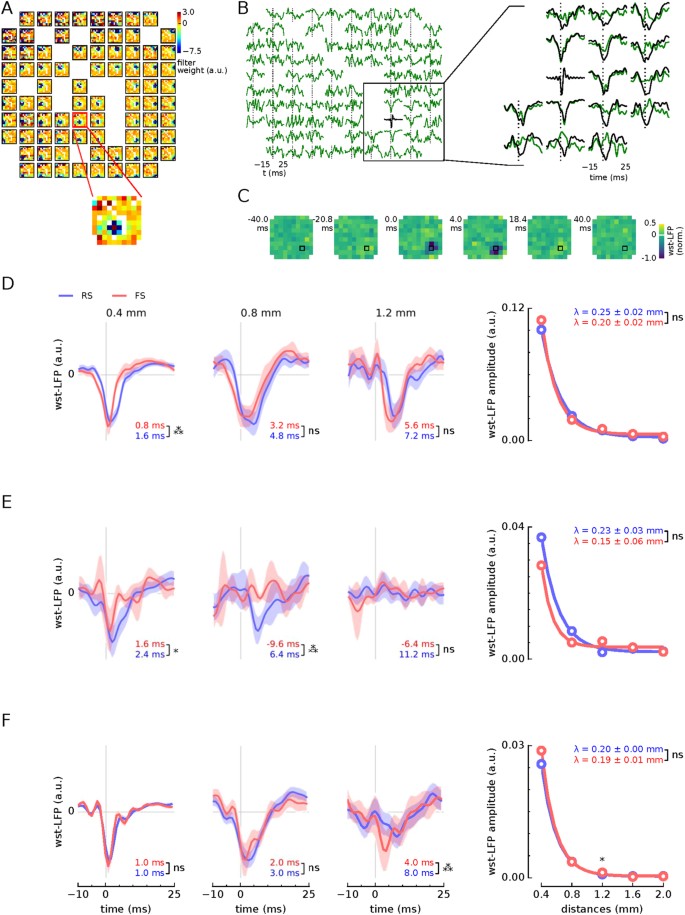
By analyzing multi-electrode array recordings from both human and macaque neocortex, the study utilizes a specialized spatial covariance filter to isolate the "unitary" LFP generated by single cell spikes from ongoing background activity. The researchers distinguished between putative excitatory (regular-spiking) and inhibitory (fast-spiking) neurons, discovering that the local fields triggered by inhibitory neurons peak at significantly shorter latencies and remain highly confined to their immediate vicinity. These findings challenge traditional assumptions by demonstrating that extracellular LFP dynamics are predominantly shaped by the activity of local inhibitory interneurons.
Links
BibTeX tap to expand
@Article{TelenczukDehghani_SpkLFP_2017,
author={Tele{\'{n}}czuk, Bartosz
and Dehghani, Nima
and Le Van Quyen, Michel
and Cash, Sydney S.
and Halgren, Eric
and Hatsopoulos, Nicholas G.
and Destexhe, Alain},
title={Local field potentials primarily reflect inhibitory neuron activity in human and monkey cortex},
journal={Scientific Reports},
year={2017},
month={Jan},
day={11},
volume={7},
number={1},
pages={40211},
issn={2045-2322},
doi={10.1038/srep40211},
url={https://doi.org/10.1038/srep40211}
}
Code & Data
The room
Abstract
The local field potential (LFP) is generated by large populations of neurons, but unitary contribution of spiking neurons to LFP is not well characterised. We investigated this contribution in multi-electrode array recordings from human and monkey neocortex by examining the spike-triggered LFP average (st-LFP). The resulting st-LFPs were dominated by broad spatio-temporal components due to ongoing activity, synaptic inputs and recurrent connectivity. To reduce the spatial reach of the st-LFP and observe the local field related to a single spike we applied a spatial filter, whose weights were adapted to the covariance of ongoing LFP. The filtered st-LFPs were limited to the perimeter of 800$\mu$m around the neuron, and propagated at axonal speed, which is consistent with their unitary nature. In addition, we discriminated between putative inhibitory and excitatory neurons and found that the inhibitory st-LFP peaked at shorter latencies, consistently with previous findings in hippocampal slices. Thus, in human and monkey neocortex, the LFP reflects primarily inhibitory neuron activity.
Citing
If you use this code or build on these ideas, please cite the paper using the BibTeX entry above.
Doors · concepts in this room
Related rooms
How Long Is the Coast of a Neuron? Resolution-Dependent Interaction Order and Computational Capacity
Field closure, ice neurons, and when a dendrite is a motif