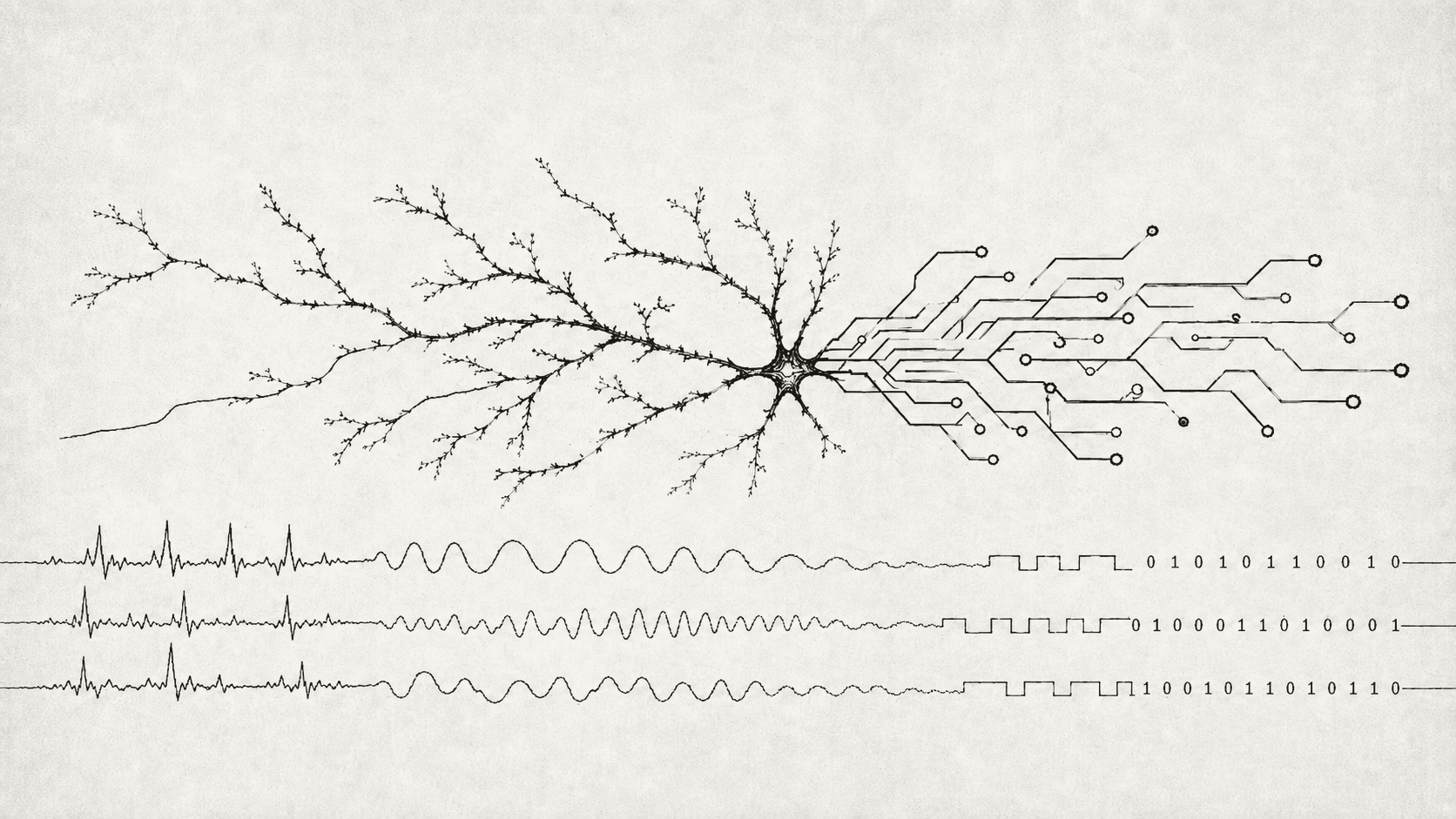
The four N‑dimensions are not separate fields but one commuting diagram: physics and computation are the hardware and learning faces; dynamics and NeuroAI are what emerges when the diagram closes.
NeuroPhysics
Statistical physics of cortical circuits. Field potentials, scaling, non-resistive extracellular media.
NeuroComputation
Information-theoretic treatments of depth. Coarse-graining and renormalisation as computation.
NeuroDynamics
Sleep oscillations, spindles, K-complexes — the transient grammar of thalamocortical states.
NeuroAI
The encompassing surface. Bridges between biological computation and machine learning.
N⁴ Research Framework
My research is organized around a central question:
How do neural and biological systems compute as physical systems?
The N⁴ framework is my way of organizing this question across four connected views: NeuroPhysics, NeuroComputation, NeuroDynamics, and NeuroAI. These are not separate research areas. They are different projections of the same object: the brain as a physical, dynamical, computational system.
The N³ formulation — NeuroPhysics, NeuroComputation, and NeuroDynamics — remains the core. N³HUB at MIT is organized around these three axes, studying the physical principles of neural function, computational models of neural processes, and the temporal organization of neural activity. NeuroAI adds the fourth surface: the attempt to translate these principles into artificial systems that compute through dynamics, structure, and physical constraints rather than only through parameter fitting.
N¹ — NeuroPhysics
NeuroPhysics asks what kind of physical system the brain is.
This part of my work studies cortical activity using the tools of complex systems physics, statistical physics, field theory, network science, and biophysics. The objects of study include field potentials, EEG, MEG, iEEG, local field potentials, extracellular media, excitation/inhibition balance, sleep-wake transitions, seizures, criticality, scaling, and collective neural states.
The central premise is that neural activity is not simply a code written on top of tissue. It is a physical process shaped by space, conductance, extracellular filtering, cellular composition, network architecture, and state-dependent constraints.
Representative questions:
- How do macroscopic brain rhythms emerge from microscopic and mesoscopic neural interactions?
- What do field potentials actually measure?
- How do excitation and inhibition organize cortical dynamics across wakefulness, sleep, and pathological states?
- When are concepts such as criticality, scaling, synchrony, and phase useful for understanding neural activity?
- How does the physical medium of the brain shape what can be computed and observed?
N² — NeuroComputation
NeuroComputation asks how computation is realized in biological systems.
This is not computation as an abstract input-output map alone. It is computation as something implemented by a physical dynamical system. I am interested in how neural systems represent, transform, compress, stabilize, and transmit information across scales.
This includes work on information theory, coarse-graining, depth, dimensionality, thalamocortical computation, cellular computation, and the foundations of physical computation. It also includes the question of how biological systems compose simpler computational motifs into larger adaptive processes.
Representative questions:
- What does it mean for a biological system to compute?
- How do neural systems coarse-grain the world?
- How do local interactions become large-scale computational states?
- How do motifs, feedback loops, and recurrent circuits support computation?
- Can physical computation be formalized in a way that applies across neural, cellular, and artificial systems?
N³ — NeuroDynamics
NeuroDynamics asks how neural computation unfolds in time.
The brain does not compute from static states alone. It computes through transients, oscillations, waves, avalanches, metastable states, and state transitions. Much of my work has focused on the temporal grammar of cortical and thalamocortical activity: sleep spindles, K-complexes, wake-sleep transitions, E/I dynamics, seizure dynamics, and collective patterns in neural recordings.
NeuroDynamics is where physics and computation meet most directly. A neural state is not merely a representation; it is a trajectory. Its meaning depends on where it came from, where it can go next, and how it is constrained by the underlying system.
Representative questions:
- How do sleep rhythms organize cortical and thalamocortical activity?
- How do transient events such as spindles, K-complexes, and avalanches structure neural computation?
- How do neural systems transition between stable, metastable, and pathological states?
- How do waves, synchrony, and collective modes contribute to computation?
- How can dynamical systems methods reveal motifs in neural recordings?
N⁴ — NeuroAI
NeuroAI asks what artificial intelligence can learn from biological computation.
For me, NeuroAI is not simply the use of machine learning to analyze neural data. It is also the reverse direction: using neuroscience, physics, and biological computation to rethink artificial intelligence.
This includes biologically inspired architectures, recurrent dynamics, reservoir computing, physical computation, fixed-weight learning, cortical inductive biases, generative models of neural activity, and compositional systems. The aim is not to copy the brain superficially, but to identify principles that may matter for intelligence: dynamics, recurrence, locality, modularity, E/I structure, multiscale organization, and computation through physical evolution.
Representative questions:
- What neural principles can become useful inductive biases for artificial systems?
- Can learning occur through dynamical state evolution rather than only through weight updates?
- How can cortical geometry, wiring, and functional organization inform recurrent neural networks?
- What would it mean to build AI systems grounded in physical and biological computation?
- How can artificial systems help us test hypotheses about neural computation?
The current research program
Across these four axes, my current work focuses on several connected programs:
1. Collective neural computation
I study how population-level neural activity gives rise to structured computation across space and time. This includes work on E/I balance, sleep rhythms, thalamocortical activity, field potentials, and multiscale neural recordings.
2. Physical and biological computation
I develop conceptual and mathematical frameworks for treating computation as a physical process. This includes work on compositionality, category-theoretic views of physical computation, cellular computation, and biological systems as adaptive physical computers.
3. Data-driven dynamical modeling
I use tools from dynamical systems, statistical physics, machine learning, and network science to extract structure from neural recordings. This includes methods for identifying motifs, waves, state transitions, and cross-scale interactions in complex neural data.
4. NeuroAI and biologically inspired intelligence
I investigate how principles from neural systems can inform artificial architectures. This includes recurrent neural networks, reservoir computing, cortical inductive biases, fixed-weight dynamical learning, and generative models of neural activity.
5. Understanding scientific understanding
I am also building a meta-research program on the nature of scientific understanding itself. This includes work on how we build models, how we extract principles from data, and how we can better communicate and organize scientific knowledge. Specifically, i am developing HypSynth (a hypothesis generation engine) and am creating a neural network-based system for data-driven scientific discovery and model building. Read the full AI4Science program →
The framework
Nima Dehghani investigates how neural systems compute across scales — from cortical microcircuits to coarse-grained representations in deep networks. The N⁴ programme treats neurophysics, neurocomputation, and neurodynamics as a single object viewed from three faces, with NeuroAI as the surface on which they meet.
This page is a living document. Notes, derivations, and the running argument for depth-as-renormalisation will be written here over time; the Paper Maze holds the discrete results, the Idea Garden the concepts that thread them.