High-frequency oscillations in human and monkey neocortex during the wake–sleep cycle
Summary
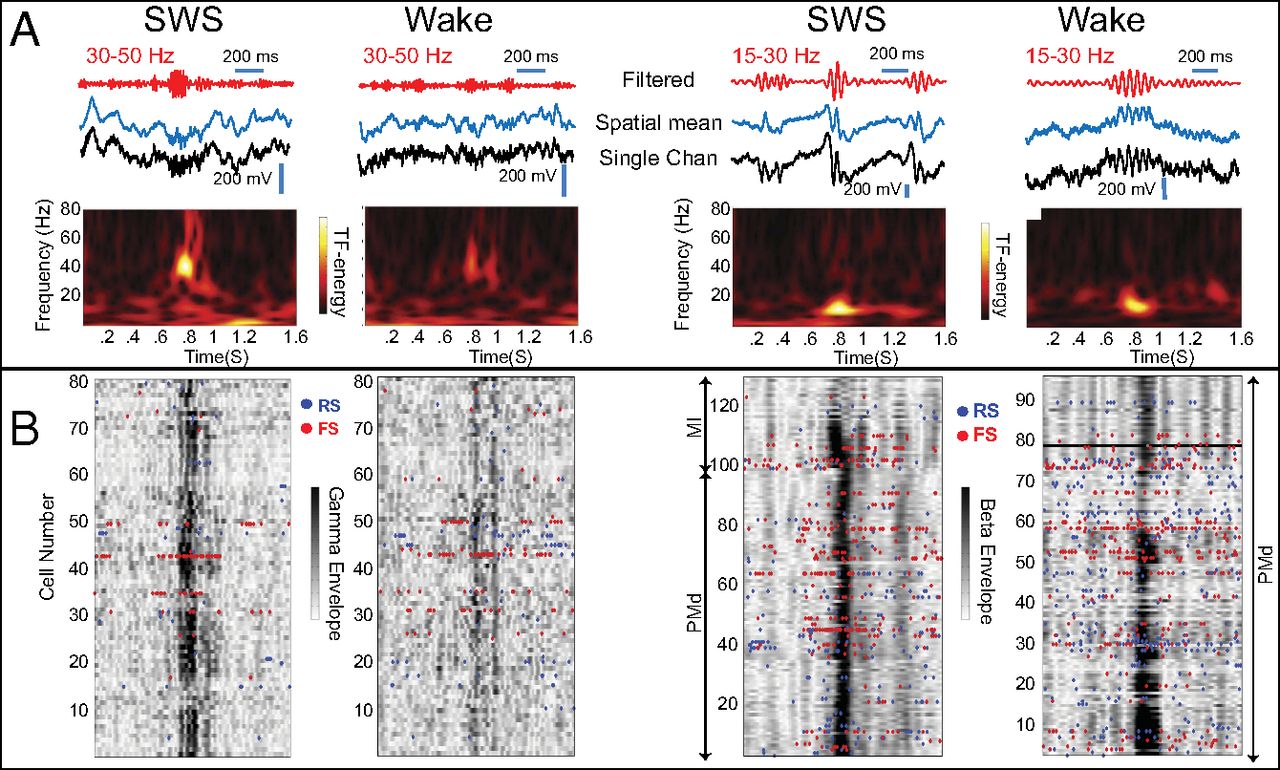
This paper investigates the cellular mechanics and spatial organization of fast brain rhythms—specifically gamma ($\gamma$) oscillations in humans and beta ($\beta$) oscillations in macaques.Using high-density microelectrode arrays to track individual excitatory and inhibitory neurons across the wake-sleep cycle, the study demonstrates that these high-frequency oscillations are predominantly driven by the active, phase-locked firing of local inhibitory interneurons. While these oscillatory waves propagate across the cortex with similar velocities during both wakefulness and sleep, they achieve a unique, highly synchronized large-scale coherence over several millimeters specifically during slow-wave sleep (SWS). These findings suggest that fast cortical oscillations provide a tightly coordinated network state during deep sleep that may support the high-fidelity reactivation of daytime neural patterns necessary for memory consolidation.
Links
BibTeX tap to expand
@article{LvqDehghaniDestexhe_fastosc_2016,
author = {Michel Le Van Quyen  and Lyle E. Muller  and Bartosz Telenczuk  and Eric Halgren  and Sydney Cash  and Nicholas G. Hatsopoulos  and Nima Dehghani  and Alain Destexhe },
title = {High-frequency oscillations in human and monkey neocortex during the wake–sleep cycle},
journal = {Proceedings of the National Academy of Sciences},
volume = {113},
number = {33},
pages = {9363-9368},
year = {2016},
doi = {10.1073/pnas.1523583113},
URL = {https://www.pnas.org/doi/abs/10.1073/pnas.1523583113},
eprint = {https://www.pnas.org/doi/pdf/10.1073/pnas.1523583113},
}
Code & Data
The room
Abstract
We show in humans that in comparison to excitatory cells, inhibitory neurons have a stronger spiking activity during γ oscillations in the wake–sleep cycle. During β-oscillations in monkey neocortex, inhibitory cells show more active firing. Unlike excitatory cells, inhibitory cells show correlations during slow-wave sleep fast oscillations over several millimeters in the neocortex. During both wake and sleep, β- and γ-waves systematically propagate with a dominant trajectory across the array with similar velocities. These findings suggest that inhibition-driven β- and γ-oscillations may contribute to the reactivation of information during sleep through orchestrating highly coherent spiking activity patterns. Beta ($\beta$)- and gamma ($\gamma$)-oscillations are present in different cortical areas and are thought to be inhibition-driven, but it is not known if these properties also apply to γ-oscillations in humans. Here, we analyze such oscillations in high-density microelectrode array recordings in human and monkey during the wake–sleep cycle. In these recordings, units were classified as excitatory and inhibitory cells. We find that γ-oscillations in human and β-oscillations in monkey are characterized by a strong implication of inhibitory neurons, both in terms of their firing rate and their phasic firing with the oscillation cycle. The β- and γ-waves systematically propagate across the array, with similar velocities, during both wake and sleep. However, only in slow-wave sleep (SWS) β- and γ-oscillations are associated with highly coherent and functional interactions across several millimeters of the neocortex. This interaction is specifically pronounced between inhibitory cells. These results suggest that inhibitory cells are dominantly involved in the genesis of β- and γ-oscillations, as well as in the organization of their large-scale coherence in the awake and sleeping brain. The highest oscillation coherence found during SWS suggests that fast oscillations implement a highly coherent reactivation of wake patterns that may support memory consolidation during SWS.
Citing
If you use this code or build on these ideas, please cite the paper using the BibTeX entry above.
Doors · concepts in this room
Related rooms
How Long Is the Coast of a Neuron? Resolution-Dependent Interaction Order and Computational Capacity
Field closure, ice neurons, and when a dendrite is a motif