Magnetoencephalography Demonstrates Multiple Asynchronous Generators During Human Sleep Spindles
Summary
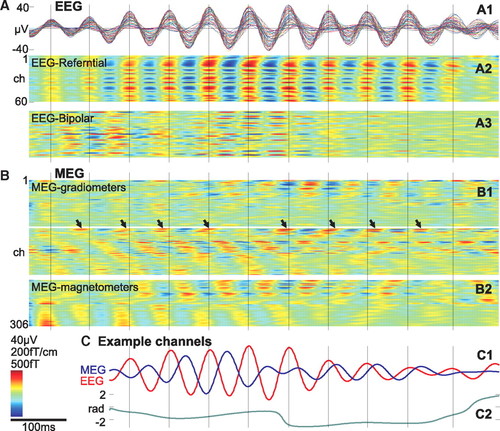
This study uses simultaneous MEG and EEG recordings to demonstrate that human sleep spindles are generated by **multiple asynchronous neural sources** rather than a single widespread, synchronized system. While EEG recordings appear highly coherent across the scalp, the MEG data reveals complex, independent generators that suggest a functional distinction between the **focal core** and **distributed matrix** thalamocortical systems.
Links
BibTeX tap to expand
@article{Dehghani_spindleGenerator_2010,
author = {Dehghani, Nima and Cash, Sydney S. and Rossetti, Andrea O. and Chen, Chih Chuan and Halgren, Eric},
title = {Magnetoencephalography Demonstrates Multiple Asynchronous Generators During Human Sleep Spindles},
journal = {Journal of Neurophysiology},
volume = {104},
number = {1},
pages = {179-188},
year = {2010},
doi = {10.1152/jn.00198.2010},
note ={PMID: 20427615},
URL = {https://doi.org/10.1152/jn.00198.2010},
eprint = {https://doi.org/10.1152/jn.00198.2010},
}
Code & Data
The room
Abstract
Sleep spindles are ∼1 s bursts of 10–16 Hz activity that occur during stage 2 sleep. Spindles are highly synchronous across the cortex and thalamus in animals, and across the scalp in humans, implying correspondingly widespread and synchronized cortical generators. However, prior studies have noted occasional dissociations of the magnetoencephalogram (MEG) from the EEG during spindles, although detailed studies of this phenomenon have been lacking. We systematically compared high-density MEG and EEG recordings during naturally occurring spindles in healthy humans. As expected, EEG was highly coherent across the scalp, with consistent topography across spindles. In contrast, the simultaneously recorded MEG was not synchronous, but varied strongly in amplitude and phase across locations and spindles. Overall, average coherence between pairs of EEG sensors was ∼0.7, whereas MEG coherence was ∼0.3 during spindles. Whereas 2 principle components explained ∼50% of EEG spindle variance, >15 were required for MEG. Each PCA component for MEG typically involved several widely distributed locations, which were relatively coherent with each other. These results show that, in contrast to current models based on animal experiments, multiple asynchronous neural generators are active during normal human sleep spindles and are visible to MEG. It is possible that these multiple sources may overlap sufficiently in different EEG sensors to appear synchronous. Alternatively, EEG recordings may reflect diffusely distributed synchronous generators that are less visible to MEG. An intriguing possibility is that MEG preferentially records from the focal core thalamocortical system during spindles, and EEG from the distributed matrix system.
Citing
If you use this code or build on these ideas, please cite the paper using the BibTeX entry above.
Doors · concepts in this room
Related rooms
How Long Is the Coast of a Neuron? Resolution-Dependent Interaction Order and Computational Capacity
Field closure, ice neurons, and when a dendrite is a motif